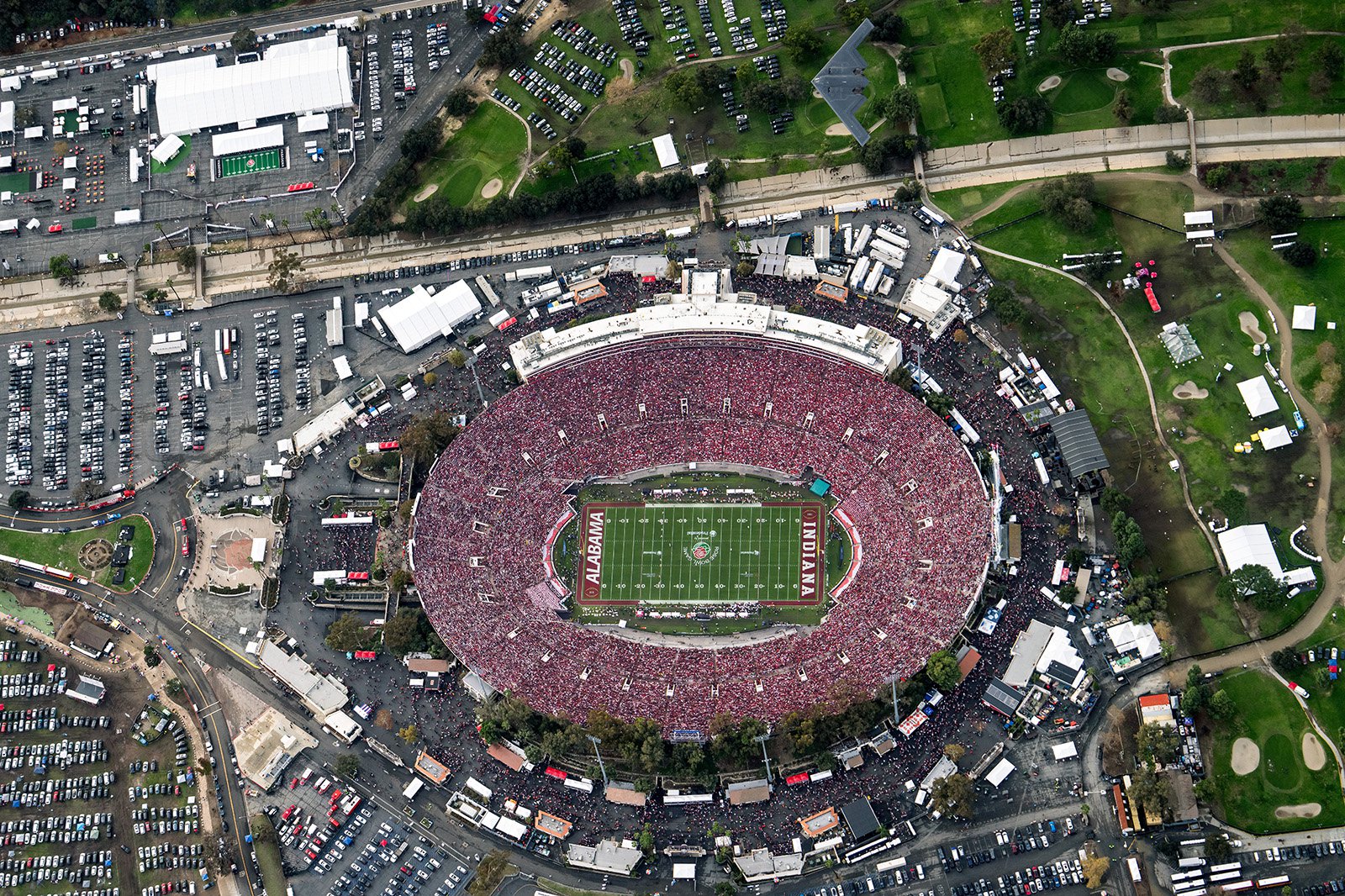
In the world of college football, the Rose Bowl Game is known as “The Granddaddy of Them All.” It is a day usually defined by postcard-perfect blue skies over the San Gabriel Mountains and the flawless precision of a B-2 flyover at the conclusion of the National Anthem. But on January 1, 2026, Mother Nature had other plans, with rain and low clouds that disrupted the usual schedule.
What followed was a day of high-stakes improvisation—not just on the field between No. 1 Indiana and No. 9 Alabama, but in the gray, cloudy skies above Pasadena, where the B-2 bomber's planned flyover contended with the uncooperative weather.
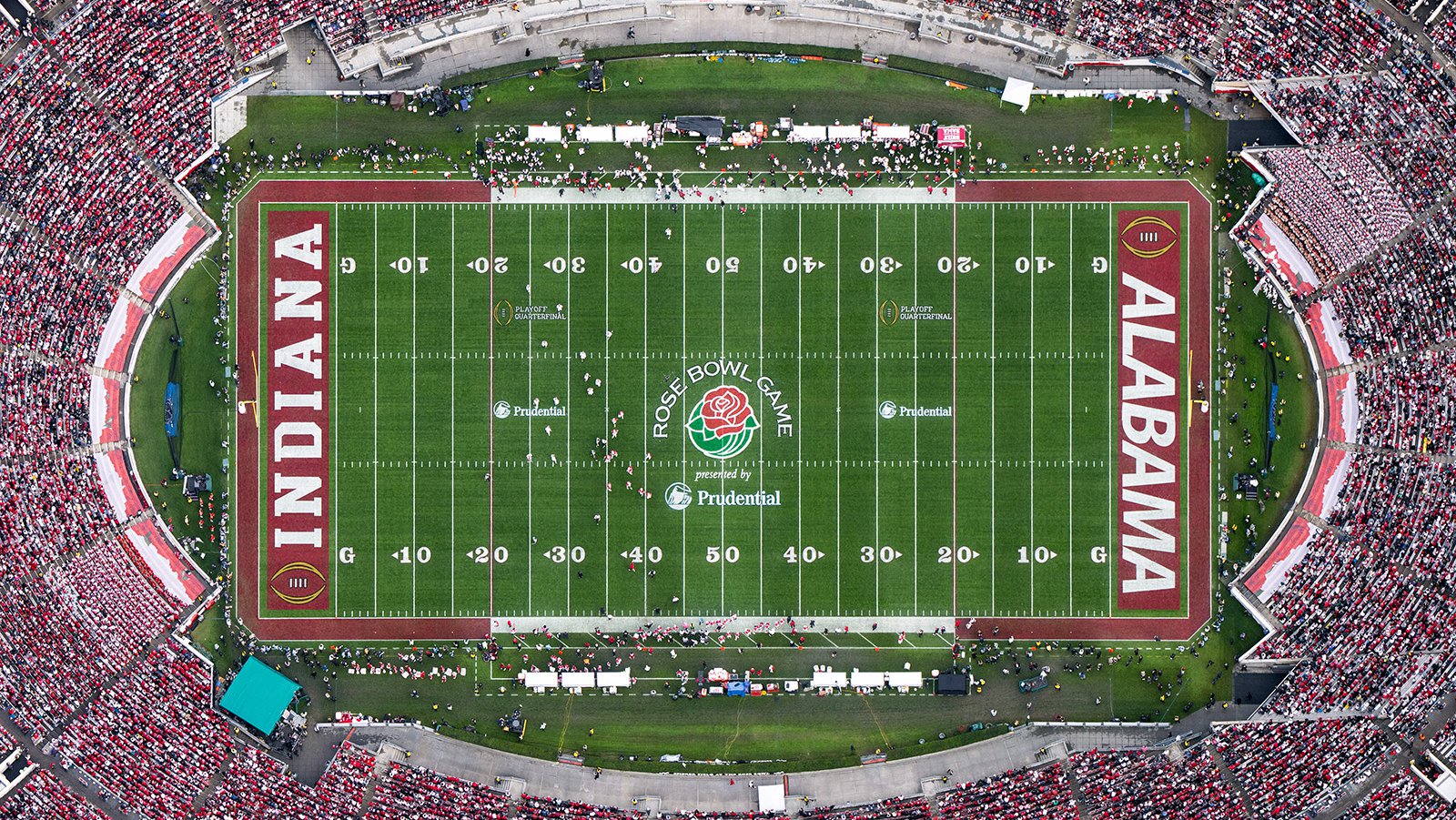
Aerial overhead view of the Rose Bowl football field showcasing the Indiana and Alabama endzones and central Rose Bowl logo, during the 2026 Rose Bowl Game in Pasadena, California.
The Matchup: Hoosiers vs. Crimson Tide
The 112th Rose Bowl Game served as a 2026 College Football Playoff Quarterfinal. On one side, the top-seeded Indiana Hoosiers, led by Heisman winner Fernando Mendoza, were looking to cap off a historic 14-0 run. On the other, Alabama Crimson Tide and Coach Kalen DeBoer sought to maintain their status as the gold standard of the sport. While the game eventually turned into a 38-3 rout for Indiana, the real drama early on was happening thousands of feet above the turf.
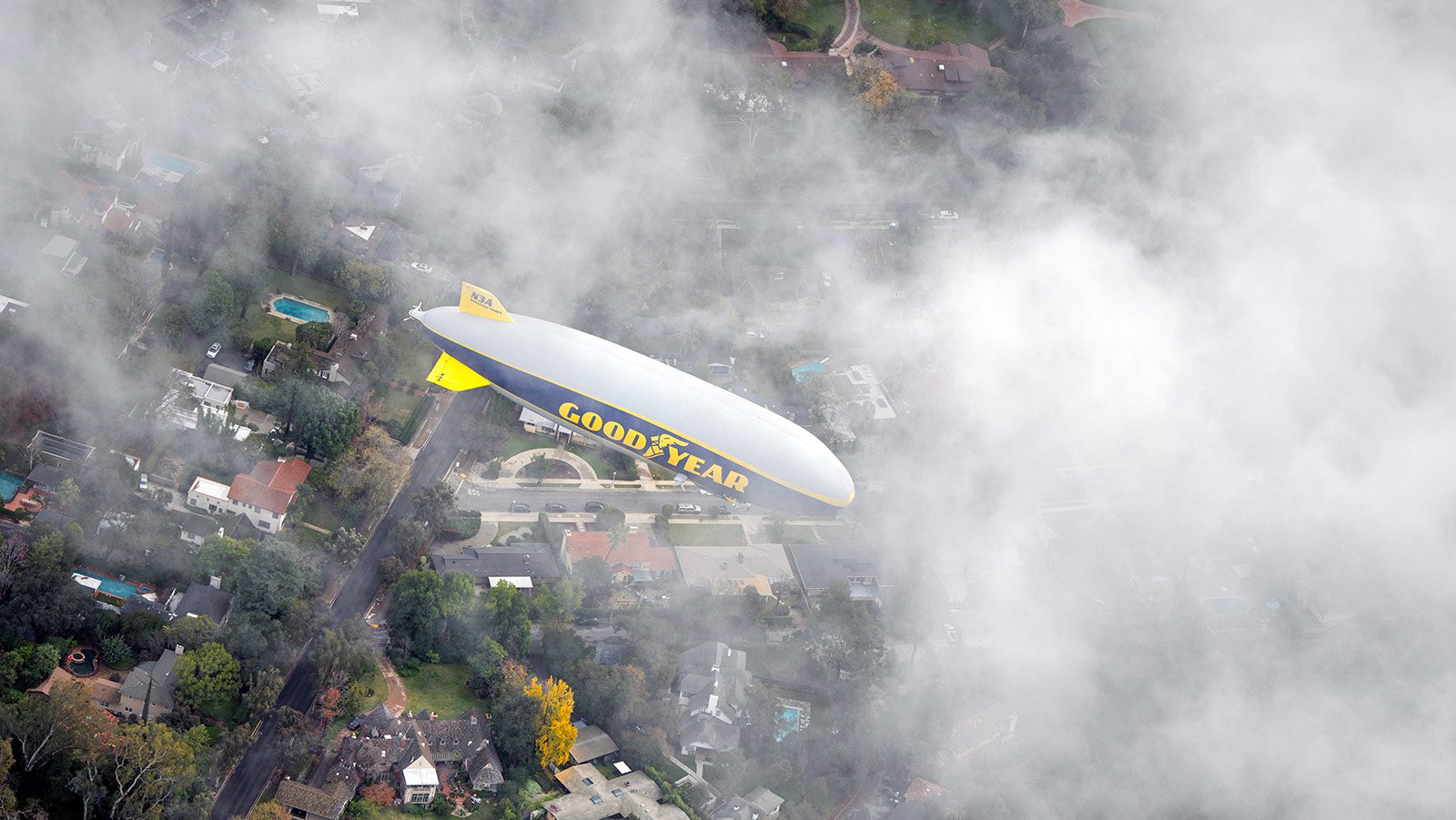
The Goodyear Blimp prepares to vanish into a dense blanket of white clouds, navigating the challenging skies over Pasadena during the 2026 Rose Bowl festivities.
The Unforeseen Obstacle: 2026’s Unusual Weather
For over 20 years, the Rose Bowl has famously avoided rain interruptions. However, in 2026, that streak ended. A powerful storm system swept through Southern California on New Year’s Eve and New Year’s morning, bringing heavy rain and a dangerously low cloud ceiling, disrupting plans for the scheduled flyover.
The B-2 typically performs two flyovers on New Year's Day, one for the Rose Parade and one for the Rose Bowl Game. By 8:00 AM, Air Force officials made the difficult decision to cancel the B-2 bomber's traditional Rose Parade flyover due to rain and low cloud cover. Hours later, as the National Anthem played before kickoff, thick gray clouds still blanketed the skies, canceling the pre-game flyover for safety and visibility reasons. Spectators were disappointed, as the iconic “whoosh” of the B-2 bomber overhead is a cherished highlight of the Rose Bowl tradition.
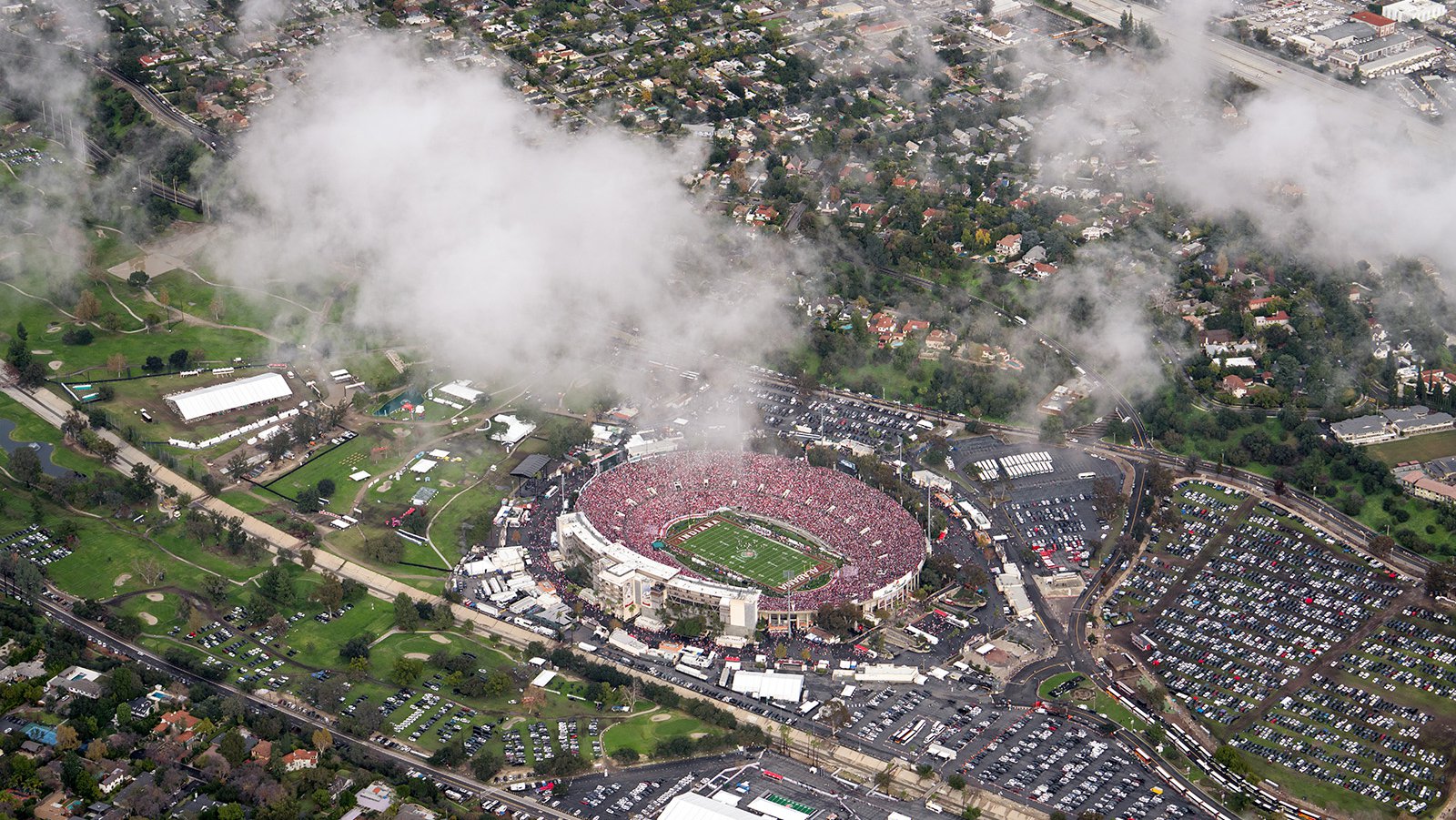
Clouds drift over the Rose Bowl stadium during the game, showing the challenging conditions aerial photographer Mark Holtzman faced while capturing the elusive B-2 stealth bomber.
The B-2 Spirit: An Aviation Masterpiece
The B-2 Spirit Stealth Bomber, operated by the U.S. Air Force’s 509th Bomb Wing based at Whiteman Air Force Base in Missouri, is a cutting-edge airplane known for its unique flying wing design and advanced stealth capabilities, making it a rare and modern marvel that often evokes awe and fascination among viewers. The B-2 stealth bomber has a long-standing tradition of flying over the Rose Bowl Game, and with the B-2 projected to be retired in the 2030s, its current flyovers are particularly significant.
On New Year's Day, instead of continuing on with their original flight plan when the scheduled morning flyovers were canceled, the Air Force crews adjusted their training exercise. They would ultimately stay airborne for over 13 hours, circling back towards the Rose Bowl Stadium in time for a halftime flyover, hoping for a tiny window of clear sky so they could complete their mission.
As the first half ended, the rain had finally stopped, and the clouds began to break into “scattered” layers, which gave the pilots just the opening they needed. Skirting below the cloud layer in the San Fernando Valley and navigating around the Verdugo Mountains, the B-2 bomber was able to make its flyover over the Rose Bowl at halftime.
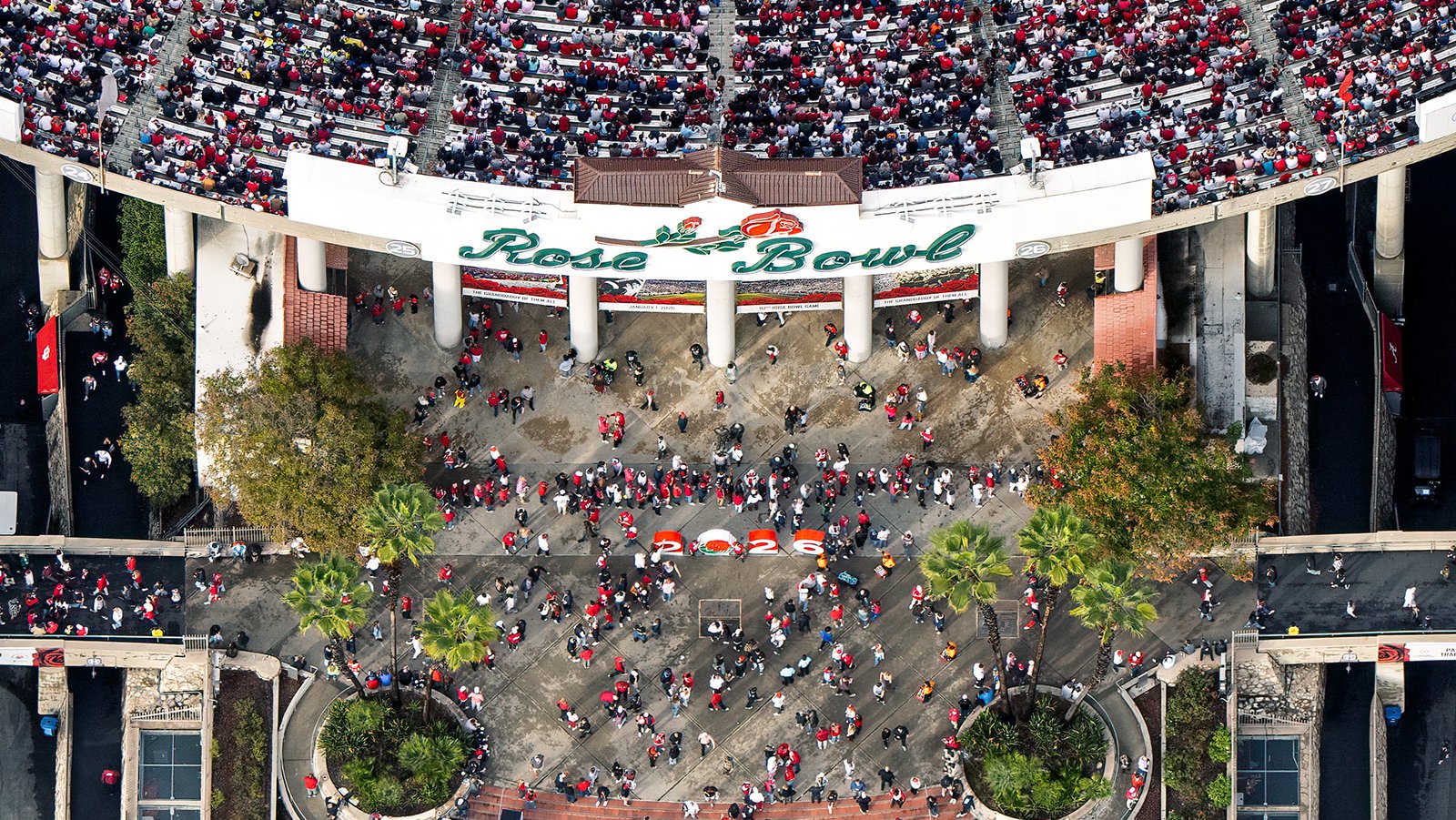
Fans gather below the iconic Rose Bowl sign at the stadium entrance, with a "2026" marker prominently displayed on the grounds, capturing the excitement of New Year's Day at the 112th Rose Bowl Game.
The Flyover Experience: Awe Above the Arena
The Rose Bowl Game flyover has become a signature tradition in Pasadena, California. Each year, the anticipation begins long before the first whistle of the Rose Bowl Game. As the Rose Parade in Pasadena begins to wind its way down Colorado Boulevard, the city buzzes with anticipation for the imminent flyovers.
But for the pilots of the 509th Bomb Wing at Whiteman Air Force Base in Missouri, the mission starts in the pre-dawn darkness. The pilots wake as early as 2 a.m. Central Time, to prepare for a journey that will take them more than 1,600 miles across the country. Their objective: to execute two tightly timed flyovers, one for the parade and another for the bowl game itself.
Air Force officials monitor the skies closely, weighing safety and visibility before giving the green light. But careful planning and preparation are sometimes not enough, and the best-laid plans can be challenged by the unpredictable. Inclement weather, like the rain and low clouds that blanketed Pasadena when the parade began in 2026, can force last-minute changes, and the team must adapt to accomplish their training mission objectives.
The flyover is a complex training exercise, demanding flawless coordination and timing. As the B-2 bomber approaches Pasadena, the crew works in concert with the Tournament of Roses, the FAA, and event officials to ensure the plane executes its pass at the precise moment. For those in attendance, the experience is unforgettable: the sight of the B-2 Spirit soaring above the stadium, framed by the backdrop of the San Gabriel Mountains and the roar of the engines as the stealth bomber passes overhead.
Mark Holtzman’s Halftime Gamble
Capturing a B-2 flyover is inherently a challenging feat; capturing it through “broken” clouds requires an act of sheer willpower with a bit of luck.
While most photographers were on the sidelines, Mark Holtzman and his team were in a Cessna 206, circling at 4,500 feet, their pre-approved and previously coordinated altitude. They faced the same challenges as the B-2 pilots:
- The Visibility: Mark and his co-pilot had to navigate around literal “holes” in the clouds to even see the stadium.
- The Timing: Because the flyover was moved to halftime, the usual synchronization with the National Anthem was out the window, requiring Mark’s spotter to keep a close eye on the surrounding areas for the incoming B-2 stealth bomber.
- The Shot: Just as the halftime concluded at 3:00PM, the B-2 emerged from under the clouds and flew over the stadium, giving Mark just moments to capture the flyover.
Mark, photographing out of his open cockpit window, quickly moved his Cessna to a gap in the clouds. After passing control to his co-pilot, he captured the B-2 Spirit against the green turf of the Brookside Golf Course below. To avoid the thick clouds that had moved-in over the stadium, Mark had needed to position himself further east than usual, so his photograph caught the B-2 just outside the stadium. Moments later, a cloud drifted between Mark and the bomber, obscuring the stadium and the B-2 from view. But a few seconds was all that Mark needed to capture the moment.
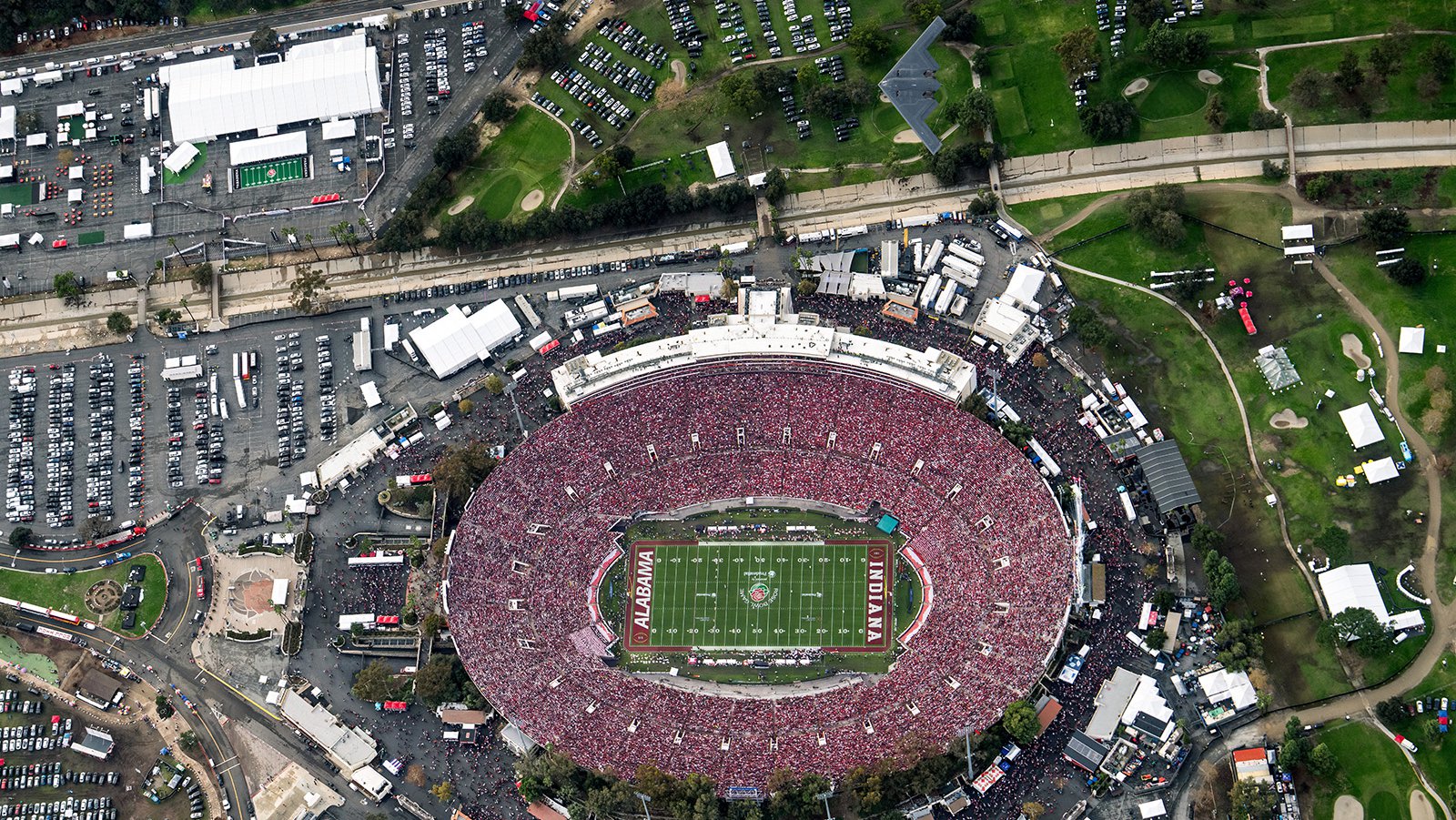
The B-2 Spirit stealth bomber passes above the Rose Bowl Stadium Pasadena, California during the 2026 Rose Bowl Game halftime, after having to patiently wait for a break in the clouds in order to successfully conduct its flyover objective.
A Tradition Preserved
The 2026 Rose Bowl Game will be remembered for the Indiana Hoosiers' dominance, but for aviation enthusiasts and those in the stands, it will be remembered as the year the Stealth Bomber refused to stay away. Through rain, low clouds, and a fifteen-hour flight in the sky, the B-2 Spirit eventually found its way home to Pasadena.